Cloud manufacturing execution solution

Cloud MES for every manufacturing site

Connect manufacturing execution data from order to shipment in one flow.

Request a consultation to receive a demo account.
MES Dashboard Real-time production execution status
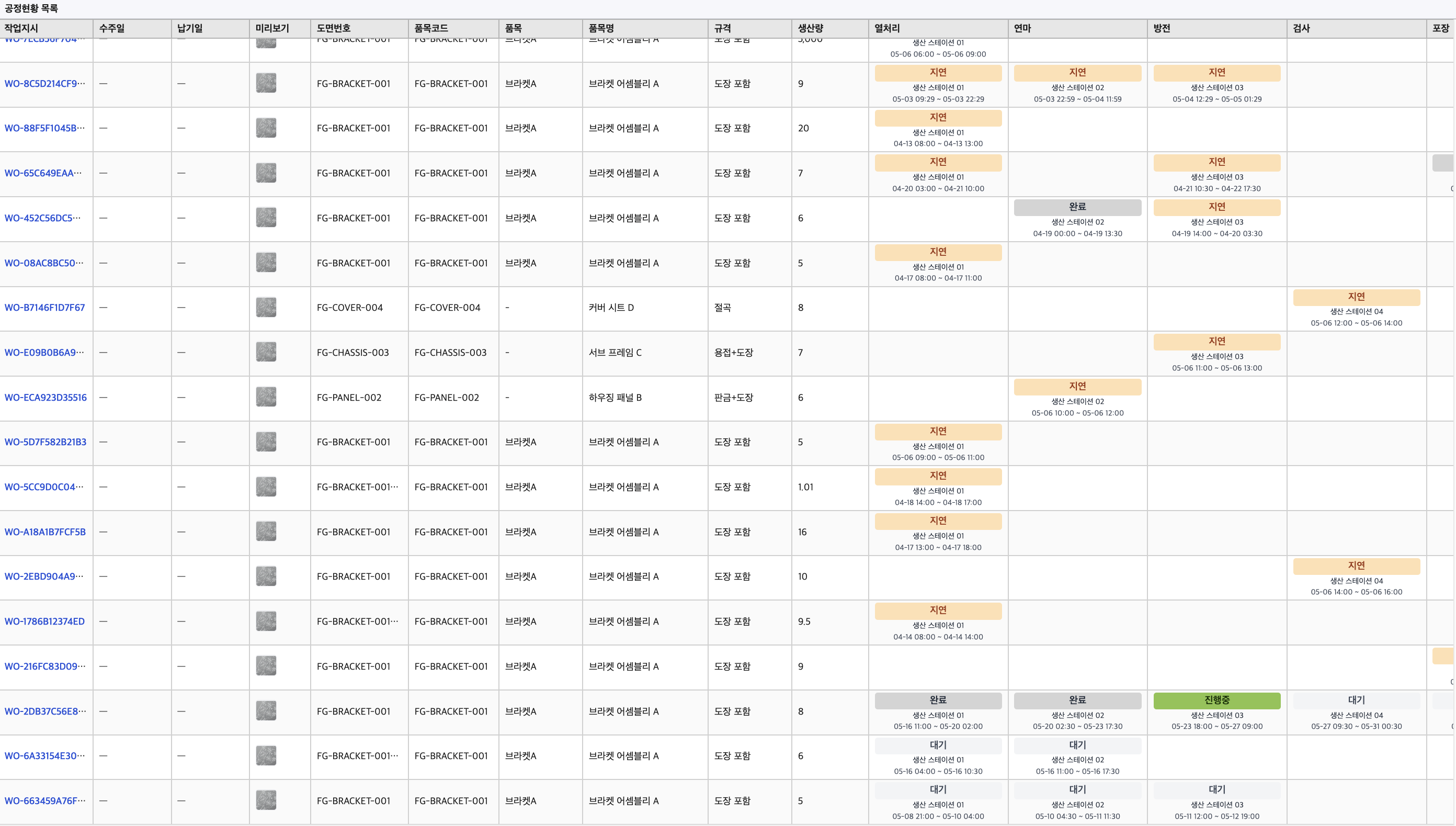
MES process status screen
Delayed jobs Instant check
QC waiting Shipment decision
Inventory status Available vs reserved

Core MES coverage areas

Order Management Work Orders Process Status Quality Inspection Defect Management Inventory Management Shipment Management Outsourcing BOM Design Change

Relying on spreadsheets and verbal reporting slows operational decisions.

01 Delayed order updates

Urgent customer order changes are not reflected in production lines quickly, causing unnecessary inventory and schedule disruption.

02 Slow status visibility

Equipment status and current process progress are hard to verify until someone checks the floor or contacts responsible staff.

03 Quality and shipment disconnected

When quality results are disconnected from shipment schedules, reaction to defects and replacement production is delayed.

Connect manufacturing execution without breaks.

  • Automatic production planning based on order data
  • Real-time inventory and process tracking with barcode/QR
  • Downtime factor analysis through equipment data integration
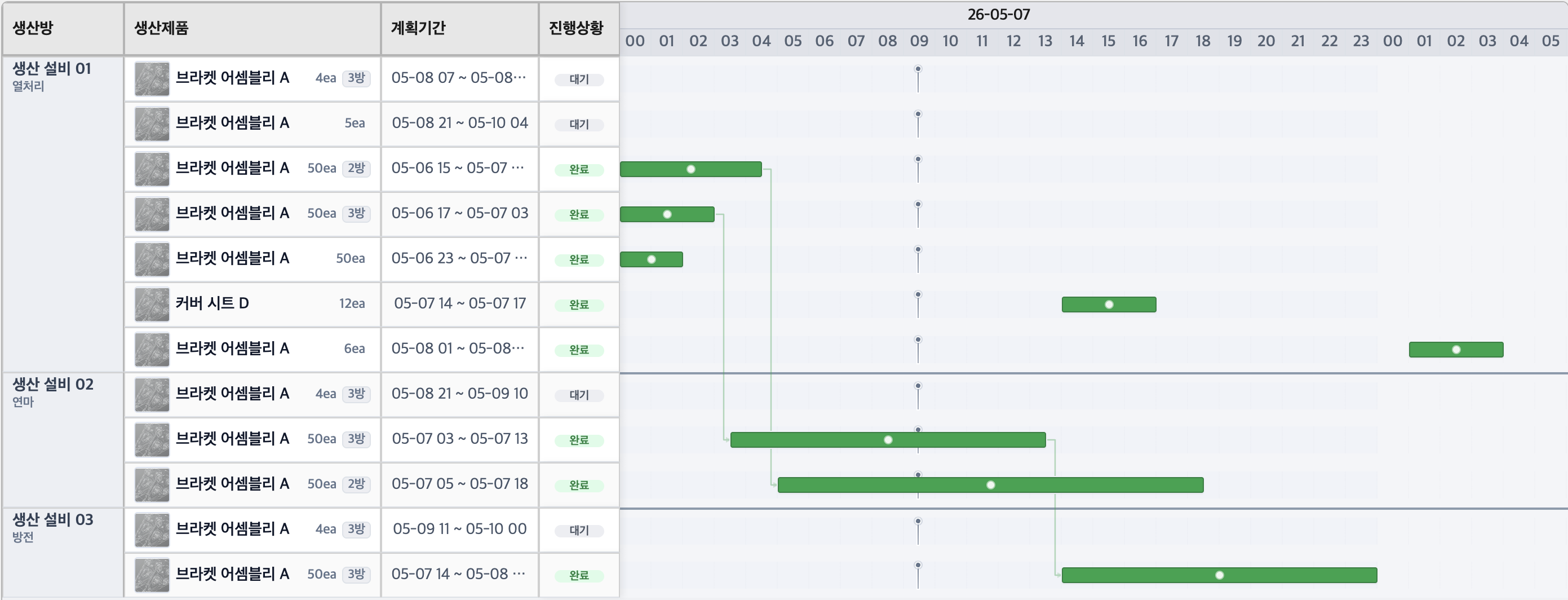
MES screen connecting process flow with equipment tasks and a Gantt timeline

Reduce both upfront investment and operating burden

A cloud MES that you can start without a dedicated server room or full-time operations staff. Validate with a small scope first, then expand features step by step.

01
For teams concerned about initial IT investment

Reduce server hardware, backup setup, and on-premise license burden, and start with only the scope you need.

8-12 weeks Typical implementation window
02
For small and mid-size manufacturers with lean IT teams

Operate through the web even without dedicated server admins, and start with a model that lowers IT operations burden.

Web Browser-based operations
03
For teams that want quick ROI validation

Apply the core flow first before full rollout, validate PoC outcomes, then scale in phases.

PoC Phased expansion ready

Implementation scope is estimated from current order sheets, work orders, production logs, inspection records, and inventory forms.

One flow from order to shipment

1 Order / Sales

Capture customer requests and plan schedule

2 Production Planning

Schedule by material and equipment capacity

CORE 3 Process Execution

Issue floor work orders and collect performance

4 Quality Inspection

In-process/final inspection and defect judgment

5 Inventory / Shipment

Store finished goods and ship on schedule

Swipe left or right to browse screens.

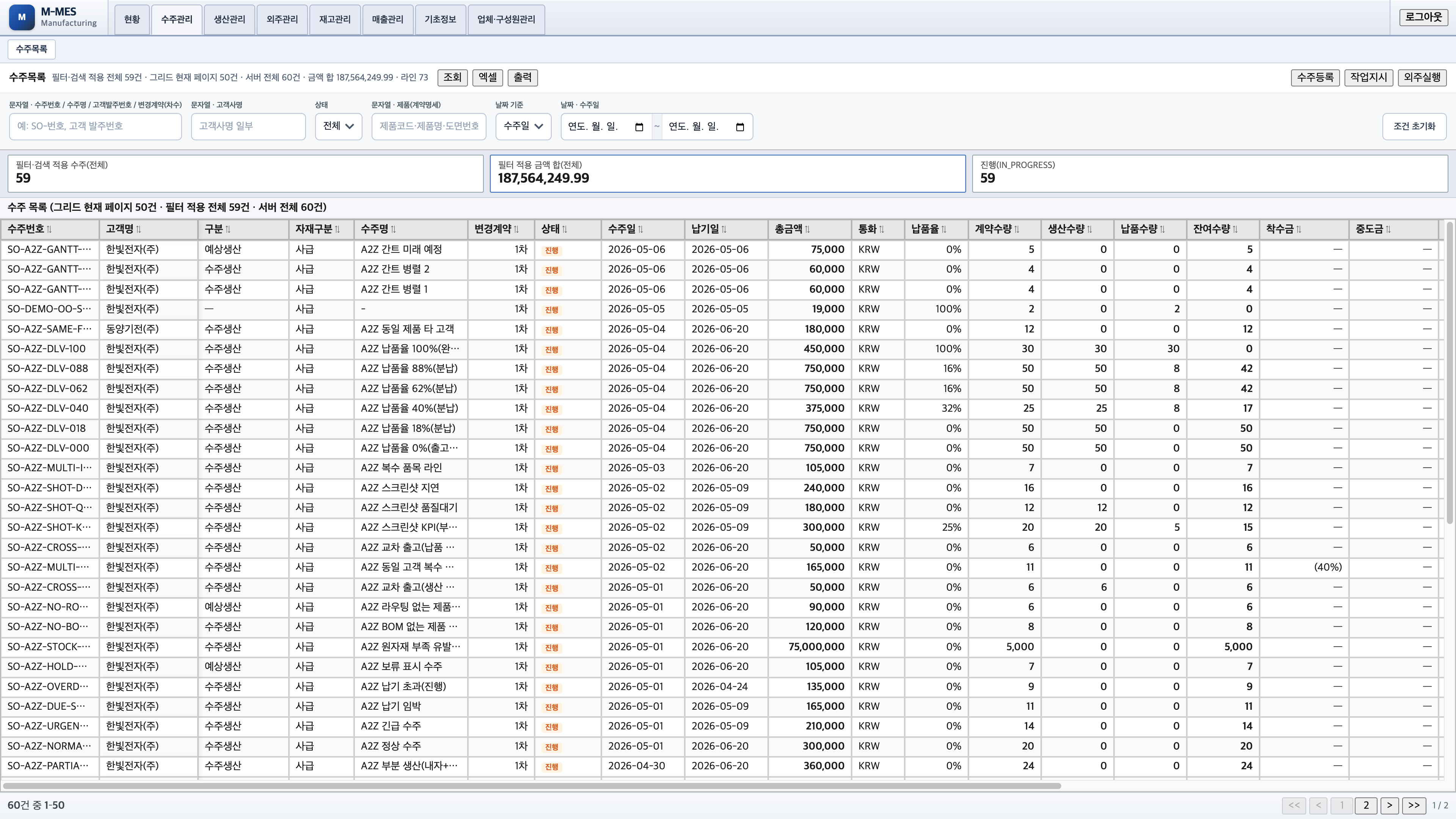
Order management screen
Order Management

Delivery rate and remaining quantity

MES is not just screens - it is the operational flow.

MES is designed around how order changes, work orders, QC waiting queues, reserved inventory, and remaining shipments actually connect in operations.

Decision criteria become clearer after adoption

Higher productivity

Improve equipment utilization and reduce idle time with accurate work instructions and process monitoring.

Stabilized quality

Reduce defect rates and trace quality history with structured inspection records by process stage.

Optimized inventory

Reflect inbound/outbound in real time to prevent overstock, stockouts, and tied-up capital.

Data-driven decisions

Make accurate management decisions based on accumulated operational data, not intuition or spreadsheets.

Prepare these items before consultation to define scope faster

01 Where do you currently manage order and delivery-date information?
Preparation

One source actually used most often (order Excel, ERP screen, order form, email, or messenger capture)

Decision criteria

Who confirms order changes and when they are reflected in work orders and shipment plans

02 How are work orders delivered to the shop floor?
Preparation

Current work-order form, printout, Excel file, shared-folder structure, or a sample work order

Decision criteria

Where missed, duplicate, or revised work orders occur most frequently

03 Who checks process progress, and when?
Preparation

Actual operational artifacts such as process board, Excel Gantt, production log, floor board, or operator reports

Decision criteria

Processes where bottlenecks frequently occur and statuses managers check most often

04 Where are inspection records and defect histories stored?
Preparation

Inspection sheets, defect reports, photos, quality Excel, inspection criteria, or customer quality-response documents

Decision criteria

Minimum information needed for pre-shipment quality decisions and traceability items

05 How do you reconcile inventory and shipment quantities?
Preparation

Inventory Excel, warehouse quantity sheets, shipment slips, transaction statements, cycle-count intervals, and reservation-quantity rules

Decision criteria

Where quantity mismatches happen most between orders, production, inventory, and shipment

Frequently asked questions

Do we need to purchase a separate server?

You do not necessarily need to buy a separate server. By choosing cloud deployment, you can reduce burdens such as initial server purchases, server-room operations, and backup infrastructure, and start with the scope you need.

For companies requiring on-premise servers or private networks, custom deployment options can be reviewed based on security policy and operating conditions.

Do we need to roll out all features from the start?

No. You do not need to introduce every area at once (order, BOM, work order, process, quality, inventory, shipment, outsourcing). A practical approach is to apply in phases, starting with the most painful workflow.

For example, start with order and work-order management, then expand step by step to process status, quality checks, inventory reservation, shipment, and outsourcing.

Can we adopt MES if we still operate mainly in Excel?

Yes. In fact, manufacturing sites relying on Excel, printouts, messenger, and verbal reporting can more easily identify which workflows to systemize first.

Using current order sheets, work orders, production logs, inspection records, and inventory tables, you can define implementation scope and data priorities.

How long does implementation take?

Implementation duration varies by scope and data readiness. A core scope focused on orders and work orders can start quickly; when including quality, inventory, shipment, outsourcing, and equipment integration, a phased rollout is recommended.

During consultation, we review your current forms and workflows, then define initial scope and phased rollout schedule together.

Can MES integrate with existing ERP or accounting software?

Integration feasibility depends on the target system architecture and interface options. After reviewing your environment (ERP, accounting, groupware, barcode systems, Excel uploads), we choose the best method among API integration, file upload, or data migration.

You can also start MES first without initial integration and connect additional systems in phases after operations stabilize.

Will shop-floor workers find it hard to use?

On the shop floor, fast checks and accurate input matter more than complex features. So operator screens should stay simple and focus on essential floor actions such as work-order check, status update, performance input, and inspection result entry.

Manager views can focus on end-to-end flow and KPIs, while floor views focus on assigned tasks through role-based screen design.

Can we manage quality inspections and defect history?

Yes. You can manage statuses such as waiting, completed, pass, fail, rework, and scrap, while recording defect causes, photos, actions, owners, and process stages as traceable history.

This quality history supports shipment readiness decisions, customer response, recurrence prevention, and process improvement.

What criteria are used for inventory management?

MES manages not only stock totals but also available, reserved, planned inbound, and planned outbound quantities. This lets you separate warehouse totals from quantities actually usable for production or shipment.

When connected to orders, work orders, production completion, inspection results, and shipment status, shortages and over-reservations are detected earlier.
Cloud MES pricing guide

Category Item Cloud MES
Implementation Initial implementation cost From KRW 40M Quoted separately based on scope and customization level
Implementation timeline Typically 3–4 months Requirements definition and analysis 1 month Development and build 2 months Customer UAT and refinement 1 month
Customization scope Full MES solution Screens and features aligned to your business workflows
Hardware purchase Included in maintenance Cloud operation helps reduce server and equipment costs of around KRW 10M
Operations Maintenance fee 15% per year of build cost Operations inquiries, incident response, and baseline maintenance included
IT staffing Vendor-managed operations and development support Reduced need for dedicated in-house IT staff
Warranty Warranty support included Defects and issues covered within the contract scope
Expansion Additional development Available Scope, schedule, and cost proposed after requirements analysis
Smart Factory government program Registered solution provider

Actual costs may vary based on customization level. Through consultation, we first clarify your current operations and required processes, then provide implementation scope and pricing.

Manage manufacturing execution in real time